
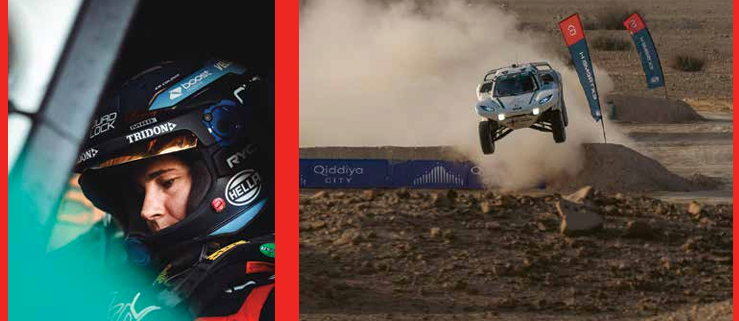
For Australian driver Molly Taylor, winning the inaugural Extreme H World Cup, an international off-road racing series for hydrogen SUVs, was a career high light. By Liz Swanton
An Australian driver is one of the first in the world to drive a hydrogen-powered racing vehicle—and she won.
With a last minute call-up to drive for Jameel Motorsport, a team from Saudi Arabia, Molly Taylor and her Swedish teammate Kevin Hansen triumphed in the inaugural Extreme H World Cup, an international off-road racing series for hydrogen SUVs. The new category has been officially sanctioned by world motorsport governing body, the Federation Internationale de L’Automobile.
Extreme H was launched in October last year with the three-day World Cup competition part of an event which included a farewell run for its predecessor, Extreme E. Extreme H is an evolution of the Extreme E (all-electric) series that ran from 2021 to 2024. Taylor unknowns we had to adapt to. won the inaugural series with another team and was leading the points tally in 2024 with Hansen when the series was cancelled.
As with Extreme E, each of the eight teams competing has two drivers, one male and one female, with equal driving duties contributing to the final results. Taylor describes last year’s event as frantic but fun.
“We had what was called ‘The Final Lap’ for Extreme E to sign off that series, and then transitioned to Extreme H. So we did a week of Extreme E and then switched to the new category.
“It certainly went well for Kevin and me to take out the first Extreme H event, to win a world title. It was a big moment in our careers, especially because we only got to see how everything would work that first week, so it was kind of all or nothing—new formula and so many unknowns we had to adapt to.
“It wasn’t just the cars that were different. We had three days with a group of different qualifying components—time trials, head-to-head shoot-outs and multi-car heats. All of that to work out which team had pole position.”
Taylor says those three days were about finding out how to optimise a new car that they were still trying to get their heads around. How to develop it, how to adapt it for each of those different challenges to find the best performance and then try to stay on top of it —and be consistently quick.
The Jameel Motorsport drivers were strong from the get-go, with podium results in most of the qualifying events, ultimately giving their team pole position for the race. Hansen opened the final with Taylor taking the second stint, passing the chequered flag more than seven seconds clear of the chasing group. “Previously, you’d have four or five cars in a heat for a final, but this time they had all eight cars running together on a dirt and sand track out in the desert with eight 2.5-tonne hydrogen off-road cars head-to-head.
“It was one of those situations where there are so many little make-or-break moments across the whole week. You just had to be on it all the time. The intensity was huge and it was some of the biggest highs I have ever experienced. It was a really good feeling to be able to maintain that and then come away with the win.”
She laughs at the memory. “Yeah, so much fun—but there was a lot of carnage!”
All the teams competing drive identical ‘cars’ built by Spark Racing Technology, which is also the constructor of Extreme E and Formula E vehicles. They have a 75kW hydrogen fuel cell and a 325kW battery. The vehicles weigh 2200kg and are capable of accelerating from 0 to 100kmh in 4.5 seconds.

“These vehicles are a bit wider than the Extreme E cars and the roll centre is a bit lower, so from that side its cornering and things like that that are more improved, which is great.
“Probably the biggest challenge is the weight. It’s 600kg heavier than the Extreme E car, so when you come to the point where you’re judging your braking and other manoeuvres, you have to remember that you are pulling up two and a half tonnes. Let me tell you, you know you’re alive! It is very similar to the Extreme E car, so there’s a lot of familiarity, but it is more powerful.”
The long-term plan is that Extreme H will eventually be classified as a world championship category, but at time of writing there were no details available as to when and where the races will be run, or how many teams will be competing. Taylor is very tight-lipped about her future with the category but admits it was exciting to get the call-up from Jameel Motorsport and win the World Cup with them, racing in the team’s home country.
“It’s terrific that the category has been endorsed by the FIA, a huge step. To be the first World Cup in hydrogen vehicles is very significant.
“It is exciting to see the series continue to grow and change. It has always been about trying to be at the forefront of what the new sustainable technologies are and how we can adapt motorsport with them. I’ve been very fortunate to be part of it.”