For Aaron Lawson, crafting a successful career in the building industry comes down to being flexible, pragmatic – and being a good people manager. By Lynne Testoni
Small towns are fantastic to live and work in. Just ask Aaron Lawson of Aztek Constructions.
But they also come with challenges. Located in Quirindi NSW, just over 60km south of Tamworth, Lawson has been running his own business for the last 25 years with a small team and a trusted collection of subcontractors. “There are five of us on the tools,” he explains. “And my wife Donna keeps the office running, does the accounting both in and out of the business, and even drafts a number of plans for our clients. She’s wonderful at helping people shape their ideas into something practical.”
Like most business owners, Lawson claims the stress and challenges of running your own business usually comes down to managing staff. “You can talk to the person in the café or your mechanic and it’s the same everywhere,” he says. “Finding good staff, keeping them, and supporting them so they enjoy coming to work—that’s the heart of every small business. We’re fortunate to have a really solid team, and we try to create an environment where everyone takes pride in what we build but also feels looked after.”
A FLEXIBLE APPROACH
Aztek Constructions does a wide variety of work including some award-winning projects, but while he would love to solely concentrate on building high-end architectural homes, Lawson says he needs to be practical. “You do have to be flexible in a small town. We love working on architecturally designed homes, but in a regional community you also want to look after people who’ve supported you for years. If a past client asks for help with their son’s bathroom, you do your best to fit it in. Being adaptable is part of what keeps a country business going and it’s something we’re proud of.”
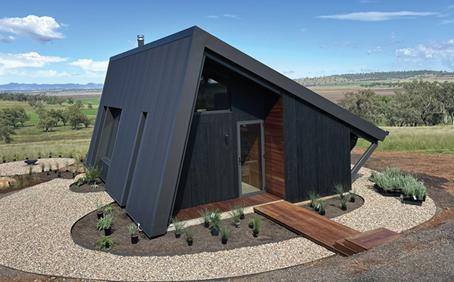
Aztek’s latest award-winning project is a farmstay retreat, designed to be off-grid and ecologically sustainable.
The project won the HIA Australian Specialised Housing award.
“Featuring bold angles, curved elements, and a warm spotted gum ply interior, it balances organic textures with modern sophistication,” the judges said. “The client came to us with a really exciting concept,” recalls Lawson.
“They had the approvals sorted before engaging us, which is not the ideal sequence from a builder’s perspective, but the architect had created something genuinely special, and it was a privilege to bring that vision to life.”
Lawson says he enjoys working on architectural projects, which provide challenges for him in terms of problem solving and developing new approaches to his craft.
“Architectural projects always stretch you in the best way,” he says. “Builders love to hate architects and their disregard for practicality, but the truth is they imagine things I never would.
The ideas they come up with push us to lift our game, try new approaches, and solve problems in ways that make the work more interesting.”
“A lot of credit goes to the architect, Cameron Anderson from Mudgee,” he adds. “He delivered a fantastic design, and his attention to detail was impressive.” Lawson says he likes working on unusual projects because they make him think. “I enjoy projects that aren’t standard because they make you grow—even though sometimes this means lying awake considering how to waterproof a tricky junction or how to execute a curved line so it meets perfectly. But when you get onsite, the team works it through, and it all comes together. That moment when you see it working exactly as intended is pretty amazing.”
FINDING QUALITY TRADES
Like most builders throughout the country, Lawson says the biggest challenge is finding and keeping good staff and subcontractors. “The hardest part is finding and keeping quality trades and apprentices. It’s not that young people don’t want to work—many do—but expectations and work styles have changed. We try to create a supportive environment where apprentices feel valued, learn properly, and understand that good craftsmanship takes dedication.
“I’m a bit traditional in that I believe in showing up, giving your best, and taking pride in the outcome—and I’m working on communicating that in a way that resonates with the newer generation. We’ve had some fantastic young people come through, and when they buy into the culture of quality, it’s rewarding for everyone.”
As for subcontractors, Lawson says that good subbies are in demand in rural areas—and word spreads fast when they are good at their job, making it hard to secure them for builds.
“Regional subcontractors are incredibly in demand. When someone is good, the whole district knows about it. We’re lucky to work with some terrific subbies, people who really care about the work, but coordinating schedules can still be tricky because everyone wants them.”
“For example, my concreter is exceptional. He’s local, he’s talented, and he’s in hot demand from Tamworth to Muswellbrook. That’s the reality of working in the country; when you find a great trade, you appreciate them and work in with them because relationships are everything.”

Photography: Supplied