
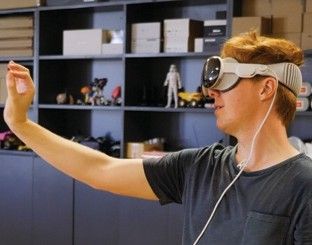
New augmented reality tech is helping tradespeople save time – but experts say many aren’t quite ready to adopt it. By Rachel Smith
When you hear the words ‘augmented reality’, futuristic movies or headsets that beam you into other worlds perhaps come to mind. But construction sites?
“AR can make construction work easier by allowing a tradie to point a phone, tablet or headset at a work area and see digital information such as building elements, services or installation instructions overlaid on the site,” says Biyanka Ekanayake, lecturer at the UTS School of Architecture and Built Environment.
However, a widening divide is emerging between larger construction companies embracing AR and smaller operators sticking to more traditional approaches. Because of this, software creators Sam Hepton and Julius Jeppe from Viewport XR, and Michael Reid from construction materials supplier Rock Stone have joined forces to create Measure and Quote LiDAR, which uses light detection and AR technology.
At a basic level, the app can scan a space, get accurate linear or area measurements and speed up the quoting and buying process, says Jeppe.
“You’re eliminating the need for pen, paper and tape measure because it can figure out exactly how much carpet or plasterboard sheets you need, and the cost.”
But for trades who still use paper time sheets, carbon copy invoices and a physical tape measure, adoption has been slow.
“Those embracing the new tech are usually younger and they walk around all day with a phone in their hand,” says Reid.
The AR being explored by large contractors is already quite impressive, says Ekanayake. “It can help workers coordinate structural and building services elements, check completed work against the design, document defects and progress and identify potential clashes before they lead to rework.”
It can also improve situational awareness by displaying known services or required clearances before excavation, she adds. “However, its reliability depends on the quality of the underlying model, specifically its alignment with the site and the accuracy of the device—so it should support rather than replace safety procedures and professional judgement.”

Investing in high level tech and training may be more realistic for commercial players at this stage, says Ekanayake. “Small scale contractors generally invest selectively, favouring tools with a clear and immediate return. Phones and tablets are probably the most realistic entry point because they’re familiar hardware and can be introduced one workflow at a time.”
Hepton says education is key for tradespeople who might be reluctant to try new tools. “There’s the need to just get into the tech and learn how to do it—and these tools will get easier and cheaper and more accessible over time.”
Room measurements, floor plans, creating scopes and quotations—and showing clients how proposed work may look—are all options with these apps.
Reid worked with some apprentices earlier this year and showed them the Measure and Quote LiDAR app, which requires an iPhone Pro.
“I said, ‘Right, how will you measure this room to know how many square metres of products you’ll need?’ They said, ‘Oh, tape measure, pen and paper.’ There were two rooms to be measured up so I said, ‘I tell you what—half of you go in this room, and half of us will go in the other.’”
In under 20 seconds, the app-using group had measurements such as height, length, square metres, lineal metres. “With the windows and doors cut out because the app does that by itself,” adds Reid. “The other team took about 7-8 minutes because they had to work it out and add it up. They were all pretty amazed.”
Hepton wishes all tradespeople would realise how powerful the phones in their pocket actually are.
“A few years ago, this tech wasn’t anywhere near consumer grade and now it’s becoming way more accurate and powerful. Ultimately, the right apps can really help you save time in your day-to-day work.”
Jeppe and Hepton are excited about prospects.
“We make software but we’re also a disruptive technology company; we like to be on that knife edge and play with all the new toys,” says Jeppe.
“My prediction is that in 5-10 years’ time wearables will be normal. People will use voice activated commands or hand gestures to quickly measure a floor, you’ll use your voice to send off a quote. We already have some of that tech on our phones, but it’ll also be on our face with AR/VR glasses.”
Ekanayake agrees. “In 5-10 years, I’d expect AR to be less a standalone technology but rather increasingly embedded within the estimating and inspection applications that builders and tradies already use.”
Photography: Supplied