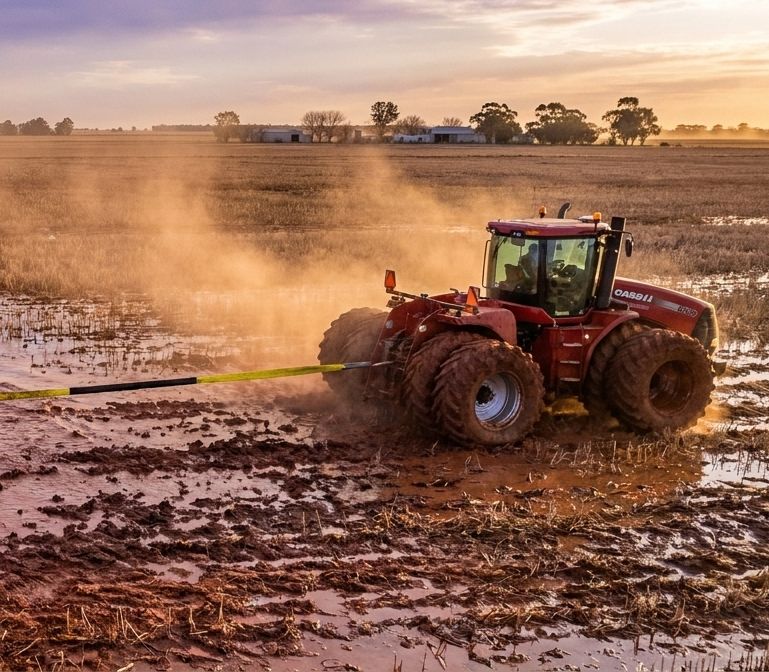
Recovering stuck vehicles and machinery is a common challenge across Australian farms. Whether it’s a bogged Ute, a tractor or truck stuck after heavy rain, or a harvester or trailer that needs repositioning, using the correct recovery equipment can improve safety, reduce downtime, and help prevent damage to valuable machinery.
While snatch straps and UHMWPE tow strops can all be used in recovery operations, each is designed for a different purpose.
Snatch Straps are designed for dynamic recoveries in which a vehicle is bogged and requires momentum to assist with the recovery. The nylon webbing stretches under load, storing energy before releasing it to assist the recovery. This controlled stretch effect helps generate the pulling force needed to free a stuck vehicle. Typically stretching around 20–30%, snatch straps store significantly more energy than low-stretch recovery products. Because of this stored energy, they also have a greater recoil potential if the strap, attachment point, or connection system fails.
Austlift UHMWPE Tow Strops are designed for towing and controlled recoveries. With very little stretch up to 5%, they transfer pulling force directly from one vehicle or machine to another. Unlike a snatch strap, a tow strop can be used to recover both powered and non-powered equipment.
that requires a steady, controlled pull and doesn’t do well under shock loading. Their lightweight construction makes them easy to carry and handle while still providing exceptional strength. UHMWPE tow strops have very low stretch (around 1–3%) and therefore store much less energy than a snatch strap.
UHMWPE soft shackles are made from the same material as the tow strop and are a better choice as an alternative to steel shackles. They are lightweight and strong, and assist in reducing the risk of heavy metal steel shackle components becoming projectiles during a failure.
When used with either snatch straps or tow strops, the combination provides the lowest recoil and projectile risk of the systems discussed.
When choosing your recovery method, take into account the following questions:
The terrain you’re operating in is flat ground, uneven surface, hilly, or sloping?
Type or ground like mud, clay, sand, or rocky ground?
The GMV of your vehicle or equipment, is it powered or non-powered?
These three questions can affect your choice of recovery, as they can increase the load resistance on your recovery.
Safety factor is another consideration that must be taken into account. Most recovery devices are calculated on the minimum breaking strain of the recovery device. This is the point when the product fails, and just because you have a 15T GMV vehicle, it doesn’t mean a 15T recovery device will do the job.

As a starting point, the safety factor should always be a 2-to-1 ratio as a minimum, and the following resistance formula should be used as a guide in addition to the added safety factor:
Light bogged: 0.5 × GVM
Severely bogged: 0.75 × GVM
Fully bogged: 1.0 × GVM (or higher)
In real conditions:
Mud suction / soft sand can push this to 1.2 – 1.5+
For example, a 15ton GVM vehicle is severely bogged, the minimum recovery strap or strop to use would be calculated like this.
15T x 2 safety factor = 30T + (0.75 x 15T GVM= 11.25T) resistance factor = 41.25t
So, your recovery strap or strop should be at least 40T minimum breaking strain.
No recovery method is risk-free. The safest recovery is always one that uses correctly rated equipment and suitable recovery points. Regardless of the method chosen, all personnel should remain clear of the recovery area while the equipment is under load.
For expert advice on the right products for the right application, contact your local CSS Member store, or call Austlift on 1300 100 120